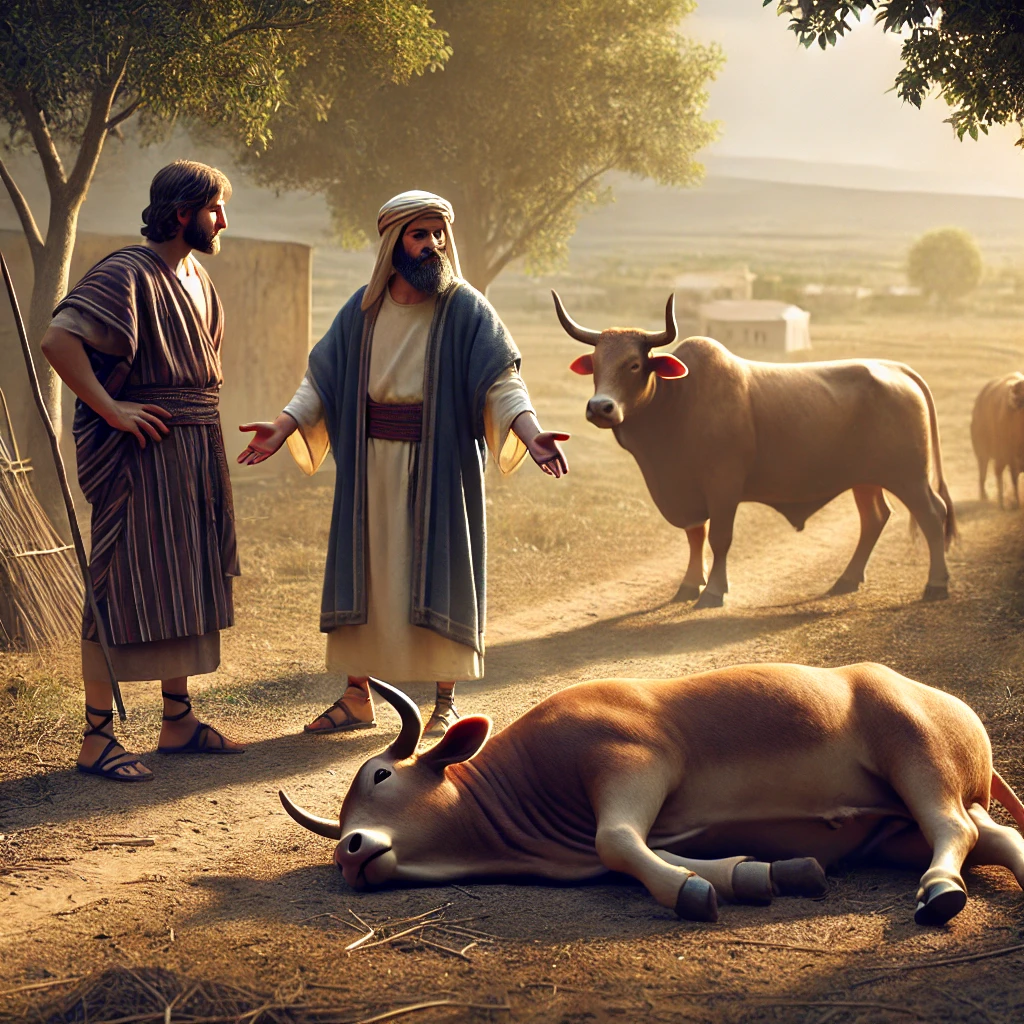
And if one man’s ox hurt another’s, so that it dieth; then they shall sell the live ox, and divide the price of it; and the dead also they shall divide. Or if it be known that the ox was wont to gore in time past, and its owner hath not kept it in; he shall surely pay ox for ox, and the dead beast shall be his own. (Exodus 21:35–36)
וְכִי יִגֹּף שׁוֹר אִישׁ אֶת שׁוֹר רֵעֵהוּ וָמֵת – וּמָכְרוּ אֶת הַשּׁוֹר הַחַי וְחָצוּ אֶת כַּסְפּוֹ, וְגַם אֶת הַמֵּת יֶחֱצוּן. אוֹ נוֹדַע כִּי שׁוֹר נַגָּח הוּא מִתְּמוֹל שִׁלְשֹׁם, וְלֹא יִשְׁמְרֶנּוּ בְּעָלָיו – שַׁלֵּם יְשַׁלֵּם שׁוֹר תַּחַת הַשּׁוֹר, וְהַמֵּת יִהְיֶה לּוֹ. (שמות כ"א, לה-לו)
The Torah distinguishes an ox with no history of goring from one known to gore. When a known dangerous ox gores and kills another, its owner must pay full damages. When an ox has no such history, the Torah does not impose direct payment, but proposes dividing the live ox and the carcass between the two owners.
If the oxen have equal value, this division effectively amounts to paying half the damage (try calculating it yourself). If one is worth more, however, its owner absorbs a larger share of the damage. This can produce absurd situations in which the injured ox’s owner receives more than the value of the ox he lost, or alternatively very little relative to his loss.
To see how unusual this rule is, imagine a traffic accident in which a luxury car such as a Ferrari hits a Fiat Uno. Would it make sense for the Fiat’s owner to receive half the Ferrari’s value? In the reverse case, what good would half the Fiat’s value do the Ferrari’s owner?
We could say that the Torah ignores extreme cases and accepts that on average the party causing the damage pays half, or that it addresses a situation where the oxen have equal value. A comparable example is the ox that kills a slave: its owner pays thirty shekels even if the slave was actually worth more or less (Exodus 21:32).
Yet something deeper seems to be involved. Had the Torah meant to say that the party causing damage pays half, it could have stated explicitly: “If one man’s ox hurt another’s, so that it dieth, he shall pay its owner half its value.” Instead, it appears deliberately to choose a formulation of division rather than payment.
Since two animals are involved, it is unclear whether their natural behavior, provocation by the injured ox, or another factor caused the incident. Since full responsibility cannot be placed on either party, the Torah treats the owners as involuntary partners and divides the loss. In the car analogy, this resembles an accident in which each party’s contribution is unclear.
The Torah therefore creates a balanced sharing of damage that requires no proof of responsibility and does not put all liability on the party that inflicted the injury. The owner of an expensive ox contributes more, but no more than half his ox’s value. This economic and legal model resembles a progressive insurance mechanism in which people of greater means pay a higher premium.
Nevertheless, if the attacking ox is exceptionally valuable, the partnership mechanism makes its owner pay more than the damage. We may assume that he could then choose to pay the damage directly, as with an ox known to gore, rather than commit to a burdensome division.
A similar rule was actually practiced in Mesopotamia centuries before the giving of the Torah. Section 53 of the Laws of Eshnunna, from the twentieth century BCE, states:
If an ox gores another ox and kills it, the two owners shall divide the price of the live ox and the value of the dead ox.
כי יגוף שור, שור אחר והמיתו, שני בעלי השוורים יחצו את מחירו של השור החי ואת שוויו של השור המת.
As Cassuto noted (Commentary on Exodus, p. 195), the Torah frequently disagrees with ancient Near Eastern laws. Here, however, it adopts the rule as right and just.
