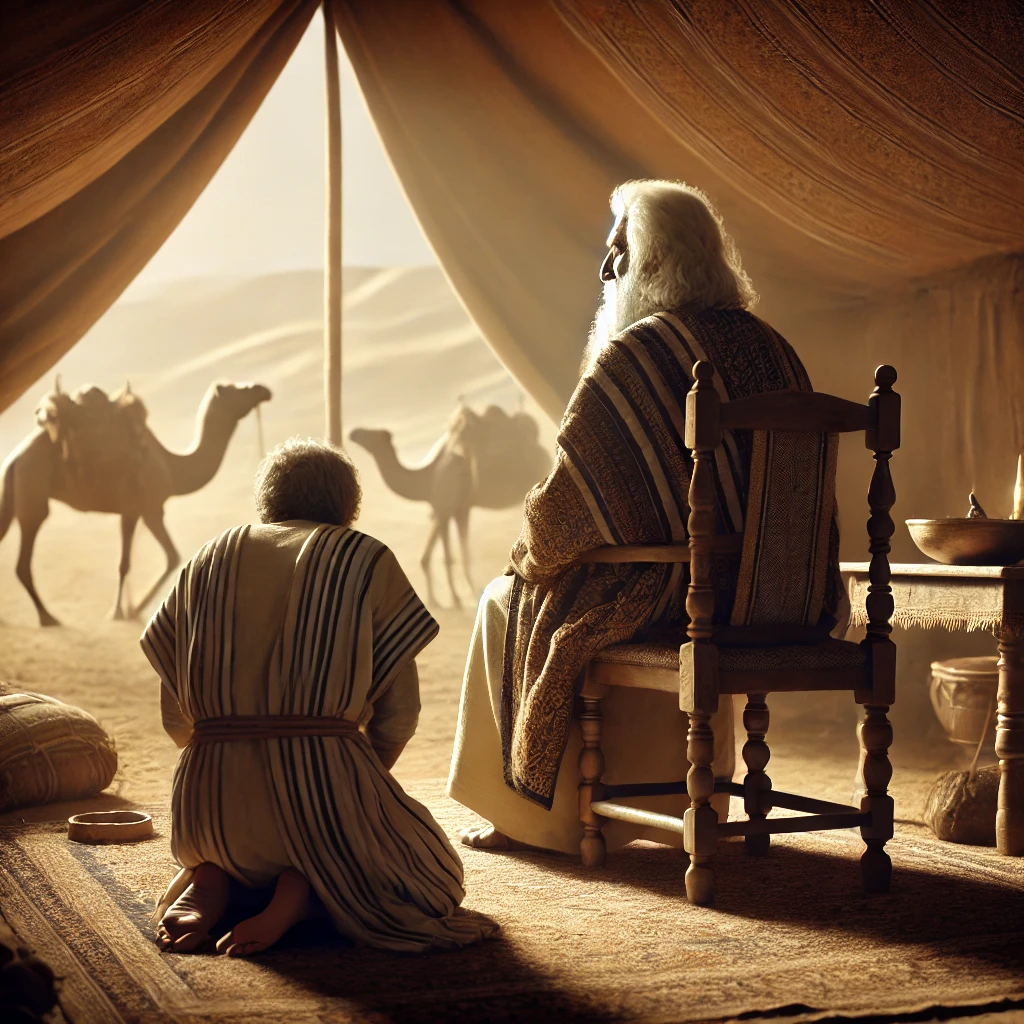
And Abraham said unto his servant, the elder of his house, that ruled over all that he had: ‘Put, I pray thee, thy hand under my thigh. And I will make thee swear by the LORD, the God of heaven and the God of the earth, that thou shalt not take a wife for my son of the daughters of the Canaanites, among whom I dwell. But thou shalt go unto my country, and to my kindred, and take a wife for my son, even for Isaac.’ (Genesis 24:2–4)
וַיֹּאמֶר אַבְרָהָם אֶל עַבְדּוֹ זְקַן בֵּיתוֹ, הַמֹּשֵׁל בְּכָל אֲשֶׁר לוֹ: שִׂים נָא יָדְךָ תַּחַת יְרֵכִי, וְאַשְׁבִּיעֲךָ בַּה' אֱלֹהֵי הַשָּׁמַיִם וֵאלֹהֵי הָאָרֶץ, אֲשֶׁר לֹא תִקַּח אִשָּׁה לִבְנִי מִבְּנוֹת הַכְּנַעֲנִי אֲשֶׁר אָנֹכִי יוֹשֵׁב בְּקִרְבּוֹ. כִּי אֶל אַרְצִי וְאֶל מוֹלַדְתִּי תֵּלֵךְ, וְלָקַחְתָּ אִשָּׁה לִבְנִי, לְיִצְחָק. (בראשית כ"ד, ב-ד)
After Sarah’s death, Abraham sent his servant to take his son a wife. He made him swear to avoid Canaanite daughters and go to his country and birthplace to find a suitable woman. Initially this seems understandable: he preferred marriage within his original group rather than among the land’s inhabitants. Jacob, too, was sent by his father to Paddan-aram to marry a daughter of Laban, his mother’s brother, rather than a Canaanite (Genesis 28:1–9).
Closer examination raises a difficulty. Abraham was commanded to leave country, birthplace, and paternal household, severing those ties for a new land where the LORD promised to make him a great nation through whom all peoples would be blessed (Genesis 12:1–3). One would apparently expect him and his family to integrate into Canaan, connect with its inhabitants, and establish their dynasty there.
Indeed, Abraham maintained good relations with local people. He had allies such as Aner, Eshcol, and Mamre (Genesis 14:13). The Hittites esteemed him as “a mighty prince,” literally a prince of God (Genesis 23:6), and he tithed to Melchizedek king of Salem, priest of God Most High, apparently also a local inhabitant (Genesis 14:18–20). Why seek his son’s wife from his original homeland instead of Canaan, where the LORD sent him?
Up to this point Scripture offers no descriptions impugning Canaan’s inhabitants. This is especially striking against Abraham and Sarah’s experiences in Egypt and Gerar. Abraham says of Abimelech’s place, for example: “Because I thought: Surely the fear of God is not in this place” (Genesis 20:11). Canaan, where Abraham and Sarah were unharmed, seemingly possessed some fear of God.
Moreover, unlike Rebekah’s explicit “I am weary of my life because of the daughters of Heth” (Genesis 27:46), Abraham expresses no principled rejection of Canaanite daughters. He establishes an initial preference, leaving an opening if the mission fails: “And if the woman be not willing to follow thee, then thou shalt be clear from this my oath; only thou shalt not bring my son back thither” (Genesis 24:8). His sole absolute prohibition concerns returning Isaac to the country of origin, rather than marrying a local woman.
The key thus seems to lie in Sarah, whose dominant influence remains after her death. The servant’s dispatch immediately follows her passing; Rebekah’s entry into Sarah’s tent shows that the mission and choice to bring her specifically from Haran were rooted in Sarah’s position and influence.
At Abraham’s departure for Canaan, he was promised, “And I will make of thee a great nation” (Genesis 12:2). This could include all his descendants, as he initially understood. Sarah, however, discerned that not all could bear his moral vocation: “that he may command his children … that they may keep the way of the LORD” (Genesis 18:19). She therefore demanded Ishmael’s expulsion, and the LORD approved: “for in Isaac shall seed be called to thee” (Genesis 21:12).
Abraham inferred that an initial gradual process of selection and refinement was required. His new family’s identity remained fragile and needed internal consolidation before facing local cultural influences. It was therefore not yet time for Isaac to marry a Canaanite. The Hebrew nucleus from which Abraham and Sarah emerged had to be established in the land through marriage to a woman from his original country and birthplace. Isaac sent Jacob to Paddan-aram for the same reason.
Already Terah’s generation displays familial movement toward Canaan: “and they went forth … to go into the land of Canaan; and they came unto Haran, and dwelt there” (Genesis 11:31). The journey stopped at Haran; only Abraham, Sarai, and Lot continued. Yet the process remained unfinished. Under Sarah’s inspiration it continued in two further waves: Rebekah’s arrival, then Rachel and Leah’s with Jacob’s entire family.
Joseph’s words in Egypt, “For indeed I was stolen away out of the land of the Hebrews” (Genesis 40:15), suggest that by Jacob and his sons’ time a Hebrew population large enough for Egyptians to identify the land accordingly existed there. This reality, apparently absent in Abraham’s time, explains why Jacob’s sons did not return to Aram-naharaim to find wives. The exceptional mention of “Shaul the son of a Canaanitish woman” among those descending to Egypt suggests his sons generally married non-Canaanite women, perhaps from the Hebrew population living in the land.
In sending the servant, Abraham thus both fulfilled Sarah’s spiritual testament and acted according to the LORD’s will: continuing selection and refinement, establishing a nation walking in His ways and carrying His blessing to the world.
