The beginning of Korah collects claims and demands from different people and groups against Moses and Aaron. At first sight these seem contradictory:
- Challenging Moses and Aaron’s special standing in the name of the entire congregation’s holiness: “for all the congregation are holy, every one of them, and the LORD is among them; wherefore then lift ye up yourselves above the assembly of the LORD?” (Numbers 16:3).
- The Levites’ demand for priesthood (Numbers 16:8–10).
- Accusing Moses of failing to bring the people to the promised land (Numbers 16:12–14).
Examining the three arguments, however, reveals a common denominator despite their differences: challenging Israel’s forms of worship, which they viewed as initiatives of Moses and Aaron. As I will show, their arguments complement rather than contradict one another.
The first claim is that distinctions of rank have no place in holiness. The entire congregation is holy, and therefore, they argue, everyone may serve in the sanctuary and bring offerings.
Moses presents the Levites’ demand for priesthood as acknowledging the priests’ special status but seeking it for themselves as well. This apparently contradicts the first demand for equality: “for all the congregation are holy, every one of them.”
This is one possible interpretation of the Levites’ words, but notice that it is Moses’ statement in an effort to dissuade them from joining the dispute. It need not reflect their claim. Their demand can instead complement the main argument: if the entire congregation is holy, there is no justification for restricting sacred service to Aaron and his sons. The Levites too, and perhaps anyone who wishes, may approach and offer.
Finally, Dathan and Abiram’s challenge appears political rather than religious, and thus unrelated to the preceding claims. But they make this argument in response to Moses’ summons. It explains their refusal to answer him, without necessarily being the focus of their challenge to his and Aaron’s leadership or the issue for which he summoned them.
I propose that Dathan and Abiram went beyond joining the challenge “for all the congregation are holy, every one of them.” They tried to implement it by establishing an alternative place of worship, and this is why Moses summoned them.
Hints appear in “the dwelling of Korah, Dathan, and Abiram” (Numbers 16:24, 27) and Moses’ request, “Respect not thou their offering” (Numbers 16:15).
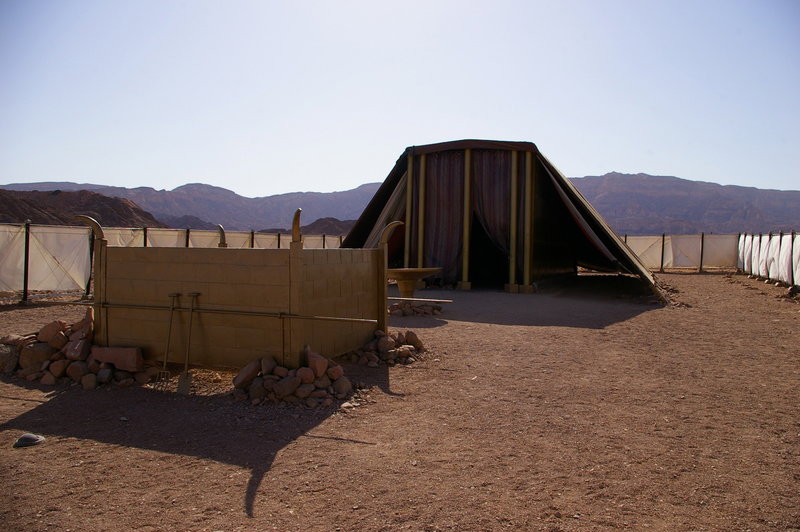
The Torah almost always uses mishkan, “dwelling” or “Tabernacle,” for the Tabernacle of the Tent of Meeting. The sole exception is poetic parallelism in Balaam’s prophecy: “How goodly are thy tents, O Jacob, Thy dwellings, O Israel!” (Numbers 24:5), where “dwellings” parallels “tents.” Here, however, the singular “the dwelling of Korah, Dathan, and Abiram” appears twice in narrative (Numbers 16:24, 27). The use of the charged word mishkan may therefore suggest more than the rebels’ residential compound.
It is also difficult to interpret “their offering” as simply the incense test, since Dathan and Abiram refused to come up and did not join the assembly at the Tent of Meeting’s entrance.
Together these hints allow us to understand Moses’ words to the LORD as referring to the alternative place of worship Dathan and Abiram established, and the offerings they and possibly other Israelites brought there. He asked the LORD not to accept them.
Dathan and Abiram’s opposition, initially seeming purely political, was thus also part of the challenge to Israel’s system of worship. In their case, according to this proposal, it went beyond a challenge to a practical attempt to establish a rival place of worship.
