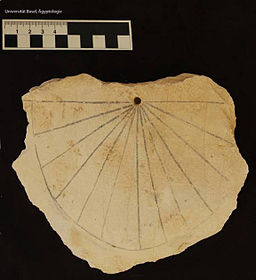
Why do clock hands move “clockwise,” from the top toward the right? Because this is the direction of a sundial’s shadow during the day. The sun rises in the east, passes through the south, and sets in the west. The shadow therefore points west in the morning, north at noon, and east in the evening. This applies only in the northern hemisphere. In the southern hemisphere, the shadow moves counterclockwise because the sun travels east to west through the north. But mechanical clocks were invented in Europe, so their direction followed the northern hemisphere. Clockwise motion is thus a cultural convention established from a particular perspective rather than a natural fact. Biblical directional language works in precisely this way.
How does this relate to the directions specified for the Tabernacle?
The Torah calls its southern side “pe’at negev temanah” (Exodus 26:18; 27:9; 36:23; 38:9). When facing forward toward the east, south is on the right, so “temanah,” rightward, suits it. Nahmanides explains: “They call south right and north left, in relation to a person facing east” (Exodus 26:18). Yet “negev temanah” sounds jarring for a Tabernacle erected in Sinai, where Israel’s Negev lies to the north.
Some see this as an anachronism introduced by a priestly writer in Jerusalem centuries later. But “negev” may already have served as a synonym for south in early Hebrew.
Biblical tradition reflects an early Hebrew association with Canaan, evident in the patriarchal stories and Joseph’s statement in Egypt that he was stolen from “the land of the Hebrews” (Genesis 40:15). In that consciousness south became identified with the Negev, the dry region of southern Canaan, and the designation continued outside Canaan. The Tabernacle’s “pe’at negev temanah” can be understood accordingly.
Others conjecture that “negev” is related through letter transposition to Arabic “janub” (جنوب), meaning a southerly direction. In that case it is primarily a directional term, with the Negev region named for its southern location rather than the reverse. This removes any difficulty in Sinai: “negev” denotes south itself, rather than Israel’s Negev region.
