Many parallels link Jacob’s burial journey and Israel’s exodus:
- Entry from the east – Both enter through Transjordan. The funeral procession first reaches “the threshing-floor of Atad, which is beyond the Jordan” (Genesis 50:10–11); only after the great lament do “his sons carr[y] him into the land of Canaan” (Genesis 50:13). This distinguishes Transjordan from entering the land itself, paralleling Israel’s exodus route.
- Carrying the dead for burial in the land – Jacob’s sons carry him; the Israelites carry Joseph’s bones (Exodus 13:19).
- An oath – Both transfers fulfill oaths: Jacob made Joseph swear to bury him with his ancestors in Canaan, not Egypt (Genesis 47:29–31); Moses took Joseph’s bones following Joseph’s oath to his brothers concerning departure (Exodus 13:19).
- Departure contrary to Egyptian wishes – As the exodus followed ten plagues before permission, Jacob’s funeral was not natural from Pharaoh’s perspective. Joseph approached Pharaoh’s servants to request permission rather than speaking directly (Genesis 50:4).
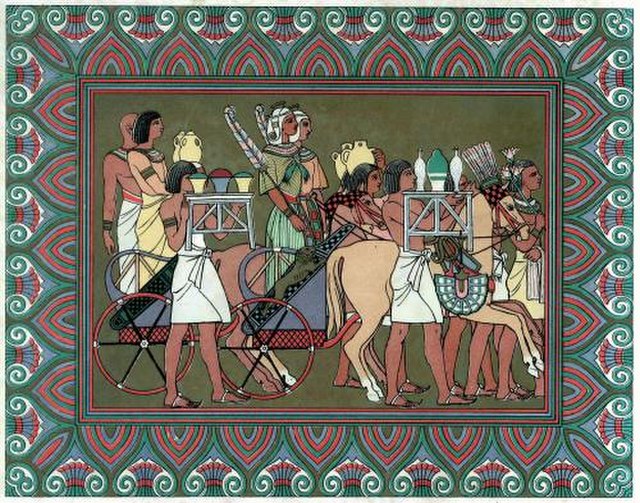
Egyptians regarded Joseph’s father as a high-ranking Egyptian: forty days’ embalming, seventy days’ mourning, Pharaoh’s servants and Egyptian elders escorting him. The procession so impressed locals that they said, “This is a grievous mourning to the Egyptians” (Genesis 50:11). Taking his embalmed body abroad was exceptional and inconsistent with customary Egyptian thinking, though ultimately permitted.
- Leaving security in Egypt – Both departures involve leaving guarantees of return. For Jacob’s burial, “only their little ones, and their flocks, and their herds, they left in the land of Goshen” (Genesis 50:8). Leaving children makes sense for a funeral, but emphasizing retained livestock is puzzling.
The exodus supplies the explanation: Pharaoh seeks to retain children, flocks, and herds to guarantee return (Exodus 10:11, 24). The funeral’s livestock detail thus anticipates his later request.
- Armed departure – Both accounts emphasize numerous, armed travelers (Genesis 50:9; Exodus 13:18).
- Regional impact – Canaanites witnessing Jacob’s great mourning in Transjordan name it Abel-mizraim. The exodus likewise impresses surrounding peoples, as Rahab tells the scouts (Joshua 2:10).
What do these parallels mean?
Jacob’s burial can be seen as “the fathers’ deeds foreshadow their children’s,” a rehearsal for the great exodus. Jacob’s and Joseph’s wishes for Canaanite burial intended precisely this: beyond aversion to Egypt, as “bury me not, I pray thee, in Egypt” (Genesis 47:29) suggests, or nostalgic desire for a self-prepared tomb, “in my grave which I have digged for me in the land of Canaan, there shalt thou bury me” (Genesis 50:5). Chiefly they signaled their descendants’ future in Israel, as Joseph’s testament indicates: “God will surely remember you, and ye shall carry up my bones from hence” (Genesis 50:25).
The journey also speaks to Israelites entering centuries later. Its message lies in taking the long southern and eastern route through Transjordan instead of the short Negev road.
The scouts’ sin condemned Israel to forty wilderness years. Punishment reflected a deeper reality: those leaving Egypt were emotionally and spiritually unready for the land. Slaves raised under foreign rule could not take responsibility and conquer independently. Forty years would shape a free generation, strengthened in faith and experience, capable of fighting, settling, and living sovereignly.
The failed southern invasion immediately after the scouts’ sin also taught that the route could not be short and direct. Conquest had to proceed gradually: first Transjordan, then Canaan itself, the LORD’s inheritance where national and spiritual vocation would be fulfilled.
Jacob’s Transjordan burial route symbolically tells descendants not to fear the long road. Wandering and delay belong to a natural, necessary maturation; even the scouts’ sin was an anticipated stage. His journey thus foreshadows slow, mature growth as prerequisite to entering the land with heads held high, faith, and maturity.
