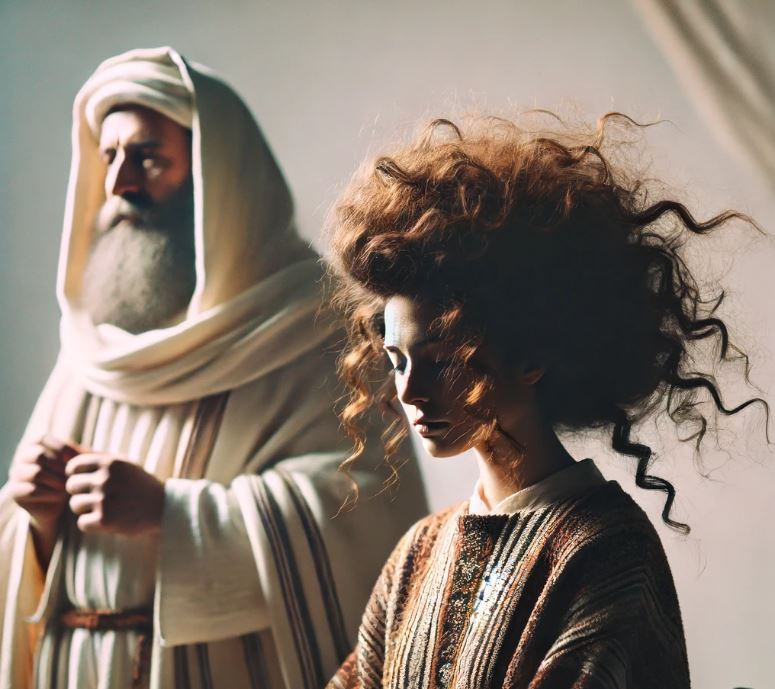
The passage about the suspected adulteress states:
And the priest shall set the woman before the LORD, and let the hair of the woman’s head go loose. (Numbers 5:18)
וְהֶעֱמִיד הַכֹּהֵן אֶת הָאִשָּׁה לִפְנֵי ה', וּפָרַע אֶת רֹאשׁ הָאִשָּׁה. (במדבר ה', יח)
Why does the priest loosen the woman’s hair?
First, according to Sifrei (Numbers 5:56), this is intended to humiliate her. At the level of the plain meaning, however, this explanation presents several difficulties.
Disheveled hair is known in the Bible as a sign of mourning: “Let not the hair of your heads go loose” (Leviticus 10:6). A person with tzaraat must let his hair go loose as a sign intended to distance him from society because of his impurity (Leviticus 13:45). Nowhere in the Torah, or in the Bible as a whole, however, is loosening the hair explicitly described as an act intended to humiliate.
Second, although the Torah’s punishments contain an element of deterrence – “And all Israel shall hear, and fear” (Deuteronomy 13:12) – no punishment has humiliation as its principal essence. Even in punishing a sinner, the Torah carefully minimizes damage to dignity beyond what is necessary. Thus although it commands hanging someone executed, it requires: “his body shall not remain all night upon the tree … but thou shalt surely bury him the same day” (Deuteronomy 21:22–23). Likewise, although it commands beating the guilty, it warns: “lest, if he should exceed, and beat him above these with many stripes, then thy brother should be dishonoured before thine eyes” (Deuteronomy 25:3). The text also does not describe loosening the hair as a public act performed before spectators, an element one would expect in a ritual intended to humiliate.
Third, when her hair is loosened, the woman has not yet drunk the water, and it is still unknown whether she is defiled or innocent. Why disfigure her and harm her dignity at this stage, when the sole purpose of bringing her to the sanctuary is to establish what happened, and her innocence remains possible?
I therefore propose that loosening the suspected wife’s hair is connected to the Nazirite’s uncut hair, the subject of the passage immediately following it. This juxtaposition may not be accidental: elsewhere in the Torah, adjacent passages also appear to carry interpretive significance.
All the days of his vow of Naziriteship there shall no razor come upon his head; until the days be fulfilled, in which he consecrateth himself unto the LORD, he shall be holy, he shall let the locks of the hair of his head grow long. (Numbers 6:5)
כָּל יְמֵי נֶדֶר נִזְרוֹ – תַּעַר לֹא יַעֲבֹר עַל רֹאשׁוֹ, עַד מְלֹאת הַיָּמִם אֲשֶׁר יַזִּיר לַה' – קָדֹשׁ יִהְיֶה, גַּדֵּל פֶּרַע שְׂעַר רֹאשׁוֹ. (במדבר ו', ה)
Growing the hair freely is the essential, central element of Naziriteship. The Nazirite’s uncut hair symbolizes his holiness. In allowing it to grow, he demonstrates that he is not subject to social conventions requiring people to style their hair. He expresses his departure from the human sphere and his entry beneath the wings of the Divine Presence. He becomes holy, belonging exclusively to God, like untouched nature not yet conquered by human beings.
The requirement to stand barefoot on holy ground, expressed at the burning bush (Exodus 3:5) and in Joshua’s encounter with the LORD’s angel (Joshua 5:15), resembles the Nazirite’s uncut hair. Shoes symbolize civilization conquering the world. In a holy place, however, a person must humble and efface himself, removing his shoes and remaining barefoot.
The prohibition on a Nazirite cutting his hair recalls Deuteronomy’s version of the prohibition on building an altar from stones worked with iron: “Thou shalt build the altar of the LORD thy God of unhewn stones” (Deuteronomy 27:6). The Torah commands whole, natural stones for building the altar, rather than stones dressed by technological means. An altar of simple natural stones symbolizes human self-effacement before God, like removing shoes or the Nazirite’s freely growing hair.
Having established the significance of the Nazirite’s hair, how does it relate to the priest loosening the woman’s hair?
In the suspected-wife case described by the Torah there are no witnesses, and what happened cannot be known. The legal system and human society cannot decide whether the woman betrayed her husband. The suspicious husband therefore turns to the LORD to decide, through administering the water to her.
Loosening her hair symbolizes that investigating her case no longer belongs to the system of human norms and law, but passes to God’s direct judgment.
