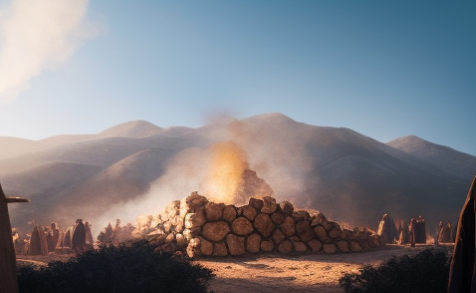
At the margins of Exodus’s account of the revelation at Mount Sinai appear several commands concerning the construction of an altar:
Ye shall not make with Me–gods of silver, or gods of gold, ye shall not make unto you. An altar of earth thou shalt make unto Me, and shalt sacrifice thereon thy burnt-offerings, and thy peace-offerings, thy sheep, and thine oxen; in every place where I cause My name to be mentioned I will come unto thee and bless thee. And if thou make Me an altar of stone, thou shalt not build it of hewn stones; for if thou lift up thy tool upon it, thou hast profaned it. (Exodus 20:20–22)
מִזְבַּח אֲדָמָה תַּעֲשֶׂה לִּי, וְזָבַחְתָּ עָלָיו אֶת עֹלֹתֶיךָ וְאֶת שְׁלָמֶיךָ, אֶת צֹאנְךָ וְאֶת בְּקָרֶךָ. בְּכָל הַמָּקוֹם אֲשֶׁר אַזְכִּיר אֶת שְׁמִי – אָבוֹא אֵלֶיךָ וּבֵרַכְתִּיךָ. וְאִם מִזְבַּח אֲבָנִים תַּעֲשֶׂה לִּי, לֹא תִבְנֶה אֶתְהֶן גָּזִית – כִּי חַרְבְּךָ הֵנַפְתָּ עָלֶיהָ וַתְּחַלְלֶהָ. וְלֹא תַעֲלֶה בְמַעֲלֹת עַל מִזְבְּחִי – אֲשֶׁר לֹא תִגָּלֶה עֶרְוָתְךָ עָלָיו. (שמות כ', כ-כב)
According to these verses, the preferred altar is an earthen one. A stone altar is permitted, but it may not be built of hewn, or dressed, stones. Steps are also forbidden.
The prohibition against building an altar with dressed stones is also mentioned in Deuteronomy:
And there shalt thou build an altar unto the LORD thy God, an altar of stones; thou shalt lift up no iron tool upon them. Thou shalt build the altar of the LORD thy God of unhewn stones; (Deuteronomy 27:5–6)
וּבָנִיתָ שָּׁם מִזְבֵּחַ לַה' אֱלֹהֶיךָ, מִזְבַּח אֲבָנִים. לֹא תָנִיף עֲלֵיהֶם בַּרְזֶל. אֲבָנִים שְׁלֵמוֹת תִּבְנֶה אֶת מִזְבַּח ה' אֱלֹהֶיךָ. (דברים כ״ז, ה–ו)
Both Exodus and Deuteronomy use the verb “to lift”: Deuteronomy says “thou shalt lift up no iron tool upon them,” and Exodus says “if thou lift up thy tool upon it, thou hast profaned it” (Exodus 20:22). The Hebrew in Exodus literally refers to a “sword.” Presumably swords were not used to build altars. Rather, the sword symbolizes the destructive dimension of human culture, and the requirement is to use whole stones – natural stones untouched by human processing that profanes them.
The prohibition against steps can and should likewise be understood within the requirement for a natural, simple altar, without steps, which express human intervention and technology. Along these lines it may also require a low, modest structure that needs no steps, like the earthen altar. This emphasizes the distance between heaven – “Ye yourselves have seen that I have talked with you from heaven” (Exodus 20:19) – and earth – “An altar of earth thou shalt make unto Me” (Exodus 20:20).
Yet the Torah supplies an additional explicit reason: the danger of exposing nakedness while ascending steps – “Neither shalt thou go up by steps unto Mine altar, that thy nakedness be not uncovered thereon” (Exodus 20:23). This requires understanding the prohibition also as removing sexuality from the sphere of worship, rather than merely as protecting the altar’s natural simplicity. The Torah thereby differs from ancient regional cultures that incorporated sex and bodily exposure into divine worship, reflected both in the cult of Baal-peor (Numbers 25:1–3) and in the account of the golden calf (Exodus 32:6–25).
According to Freud, Thanatos and Eros – the drive toward destruction and the sexual drive – are the fundamental forces motivating humanity. The sword lifted over the altar’s stones, profaning them, and the concern about exposed nakedness on its steps can be seen as symbols of these two forces.
Unlike Deuteronomy’s account, emphasizing the positive requirement of an altar made of whole, natural stones, Exodus emphasizes the negative, profaning aspect of shaping the altar by human means and the danger of nakedness on its steps. Both, however, reveal a common tendency to limit expressions of human culture and drives in worship, returning precisely at the point of encounter with God to the simple and natural.
The altar’s construction instructions at the margins of the Sinai revelation teach that encountering God requires a conscious reduction of human presence and its central forces – destruction and sexuality. These forces are not rejected; God Himself gave them to humanity. Their exercise is suspended at the point of encounter with God, to make room for the divine presence.
