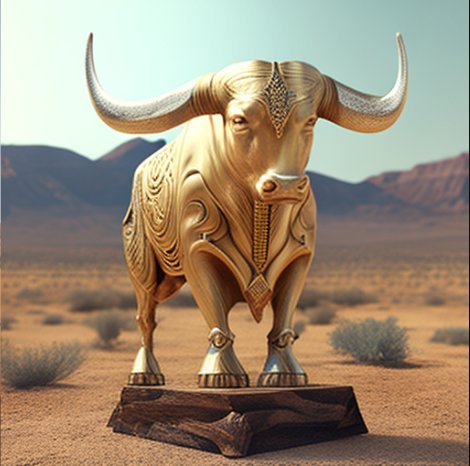
And when the people saw that Moses delayed to come down from the mount, the people gathered themselves together unto Aaron, and said unto him: ‘Up, make us a god who shall go before us; for as for this Moses, the man that brought us up out of the land of Egypt, we know not what is become of him.’ (Exodus 32:1)
וַיַּרְא הָעָם כִּי בֹשֵׁשׁ מֹשֶׁה לָרֶדֶת מִן הָהָר, וַיִּקָּהֵל הָעָם עַל אַהֲרֹן וַיֹּאמְרוּ אֵלָיו: קוּם, עֲשֵׂה לָנוּ אֱלֹהִים, אֲשֶׁר יֵלְכוּ לְפָנֵינוּ – כִּי זֶה מֹשֶׁה הָאִישׁ, אֲשֶׁר הֶעֱלָנוּ מֵאֶרֶץ מִצְרַיִם, לֹא יָדַעְנוּ מֶה הָיָה לוֹ. (שמות ל"ב, א)
Moses was late descending the mountain, and the people feared something bad had happened to him. Aaron apparently did not know when Moses was due to descend, or he could have reassured them. The natural response was to find a replacement, even a temporary one.
Their request, “Up, make us a god,” could mean appointing a powerful ruler to replace Moses, with “elohim” denoting a leader and judge, as in the parallel between God and a prince: “Thou shalt not revile God, nor curse a ruler of thy people” (Exodus 22:27). “Make” could likewise mean preparing, raising, and instructing Moses’ replacement, rather than making an object such as a statue. Compare “the souls that they had gotten in Haran” (Genesis 12:5), literally “made,” and Samuel’s words: “It is the LORD that made Moses and Aaron, and that brought your fathers up out of the land of Egypt” (I Samuel 12:6).
But if the people requested a human replacement for the absent Moses, Aaron could have proposed an agreed candidate or selected one by lot. Instead he requested gold and fashioned a molten calf with a graving tool. Perhaps he believed Moses would return and did not want to appoint a successor. But how could a golden calf fill Moses’ absence?
Some of the people regarded Moses, called the man of God, as more than a human leader: he symbolized the LORD’s presence among them, blurring the difference between him and God, in the sense that a person’s emissary is like the person himself. When describing the LORD’s absence from the presumptuous attack on the mountain, for example, the Torah links Moses with the ark: “but the ark of the covenant of the LORD, and Moses, departed not out of the camp” (Numbers 14:44). Moses also tells Jethro, ambiguously, “Because the people come unto me to inquire of God” (Exodus 18:15), and so forth.
Those who approached Aaron sought a replacement for the divine Moses rather than another leader. A powerful bull statue representing the LORD – “This is thy god, O Israel, which brought thee up out of the land of Egypt” (Exodus 32:4) – could thus replace Moses for them. Aaron could continue as its prophet and spokesman, as he had been for Moses.
What, however, did Aaron believe? It is difficult to assume that he and the people thought and acted identically, since their punishment should then have been identical. Moses would have had to kill his brother, just as he required the Levites to kill their brothers and relatives: “Consecrate yourselves to-day to the LORD, for every man hath been against his son and against his brother; that He may also bestow upon you a blessing this day” (Exodus 32:29), practicing what he preached. It is also inconceivable that Aaron would continue as high priest after grave idolatry, even under threat, which is nowhere mentioned.
Cassuto explains that Aaron’s intention, heaven forbid, was not to construct a physical representation of God, as those parts of the people understood it. His purpose was to represent God’s throne through a golden calf. He thought this physical throne representation could temporarily replace Moses, who represented God’s presence and leadership for the people.
This is not far-fetched: in the Tabernacle whose construction Moses was being commanded on Sinai at that very time, the throne of the LORD, the One enthroned upon the cherubim, was sheltered by golden cherubim. These are winged mythological creatures with the legs of a bull or calf.
Aaron’s calf therefore represented only the LORD’s throne or chariot, like the ark and its sheltering cherubim in the Tabernacle (compare “And He rode upon a cherub, and did fly,” II Samuel 22:11). He thought it appropriate in the circumstances as a temporary replacement for Moses until his descent.
