And thou shalt make staves of acacia-wood, and overlay them with gold. And thou shalt put the staves into the rings on the sides of the ark, wherewith to bear the ark. The staves shall be in the rings of the ark; they shall not be taken from it. (Exodus 25:13–15)
וְעָשִׂיתָ בַדֵּי עֲצֵי שִׁטִּים וְצִפִּיתָ אֹתָם זָהָב. וְהֵבֵאתָ אֶת הַבַּדִּים בַּטַּבָּעֹת עַל צַלְעֹת הָאָרֹן, לָשֵׂאת אֶת הָאָרֹן בָּהֶם. בְּטַבְּעֹת הָאָרֹן יִהְיוּ הַבַּדִּים – לֹא יָסֻרוּ מִמֶּנּוּ. (שמות כ״ה, יג–טו)
The Sages understood this as a prohibition against removing the ark’s staves. On the plain meaning, however, it may describe an object with permanently attached staves – a statement of fact rather than a command. Either way, their permanence, unlike those of the other furnishings, requires explanation.
Rabbi Joseph Kara explains that, because of the ark’s holiness, the Torah commands leaving its staves in place to avoid unnecessary contact when dismantling and erecting the Tabernacle. Yet, preparing for a journey, the priests explicitly handle the ark and its staves, cover it, and prepare it for carrying (Numbers 4:5–6). Leaving the staves in place thus did not eliminate handling or contact. Rabbi Joseph Kara’s explanation therefore seems not to resolve the difficulty.
Hizkuni adds that, unlike the other furnishings, the ark’s staves need not be removed because they do not obstruct anyone: only the high priest enters the Holy of Holies, on the Day of Atonement. This too is insufficient. On the plain meaning, Moses regularly enters the Tent of Meeting: “And there I will meet with thee, and I will speak with thee…” (Exodus 25:22), and “And when Moses went into the tent of meeting…” (Numbers 7:89). Moreover, even without practical obstruction, the exposed carrying poles impair the ark’s appearance when it stands in place. An essential explanation, rather than merely a technical one, is needed.
There therefore seems room to propose an essential difference between the ark’s staves and those of the other furnishings. The latter served to carry the objects during journeys and were removed when the Tabernacle was erected. The ark’s staves, by contrast, are integral parts of the ark itself, as well as means of carrying it. Hence the Torah’s emphasis: “they shall not be taken from it.”
The ark and the cherubim sheltering it serve as the throne of the LORD, called the One “enthroned upon the cherubim,” but it is no ordinary chair. Their structure is more like a chariot. Just as removing the wheels of the king’s chariot while it stands in his palace would be unthinkable, removing the ark’s staves when it rests in the Tabernacle is inappropriate.
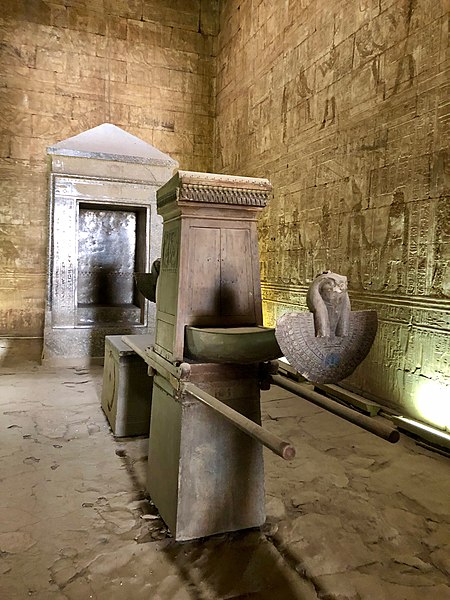
The cultural background of the ancient Near East, especially temples with ritual processions, also sheds light on the ark and its staves. In the temple of Amun-Ra at Karnak – with every distinction between the two – a sacred boat bore the deity’s statue. Long poles ran along both sides, and at major festivals such as Opet the priests carried it in procession outside the temple.
The Torah describes no regular practice of taking the ark outside the Tabernacle apart from journeys. Nevertheless, we may infer that it went out to war, since the Torah emphasizes that in the exceptional case of the presumptuous attack it did not accompany the fighters, because the battle opposed the LORD’s will (Numbers 14:44).
This understanding is supported by I Samuel 4:3–11, describing the ark’s removal from Shiloh to the battlefield against the Philistines (I Samuel 4:3). Uriah the Hittite’s words to David (II Samuel 11:11), implying that the ark was with the fighters, give further support.
Accordingly, the familiar verses quoted when taking out and returning the Torah scroll – “And it came to pass, when the ark set forward, that Moses said: ‘Rise up, O LORD, and let Thine enemies be scattered; and let them that hate Thee flee before Thee.’ And when it rested, he said: ‘Return, O LORD, unto the ten thousands of the families of Israel’” (Numbers 10:35–36) – may describe the ark’s departure for war and return, rather than the camps’ journeys.
The ark’s role thus extends beyond the Tabernacle. Its staves, symbolizing mobility, express the LORD’s presence accompanying Israel outside the Tabernacle, in journey and war. The divine presence rests with the people everywhere, rather than being fixed in one place.
